Onchain lending has roughly $86B supplied and $26B borrowed. The idle $60B is not the interesting number. The composition of the $26B is.
Nearly all of it is a variation on one position: looping, basis and carry, and borrowing to avoid selling. All three are long crypto. They grow when collateral appreciates and unwind when it does not. Category active loans peaked at $37.6B on 28 January 2026 and sit at $26B today, a 30% drawdown. Credit did not get expensive. The trade got worse.
Lending category aggregates, Token Terminal, 8 September 2026.
This is a collateral problem, not a demand problem. A venue that accepts ETH, BTC and staked ETH has already chosen its borrowers: people whose whole balance sheet is crypto, and whose only reason to borrow is a view on crypto.
So a new rate mechanism does not produce a new borrower. It reprices the same one. And because that borrower is everywhere at once, utilization and yield fall together, everywhere, at the same time. That is the part that should worry anyone building a deposit product. The yields are not simply low, they are perfectly correlated.
What different demand actually looks like
Different demand comes from a business cycle rather than a price view.
This is not a new product. Securities-based lending, called Lombard lending in European private banking, is one of the oldest secured credit products there is: borrow against a portfolio so you do not have to sell it. Every private bank offers it, both as a revolving line and as fixed-term advances at a locked rate against the same collateral pool. It has no onchain equivalent because the collateral cannot be pledged to a smart contract, not because anyone doubts the demand.
The abstraction hides how ordinary this borrowing is.
A fund meeting a redemption window. An allocator holds a tokenized credit or money market position. Redemption requests arrive on a quarterly gate, and the fund has thirty days to fund them. The position itself may take a week to redeem at the issuer, or may only redeem on a monthly cycle, or may be sitting at a discount the manager does not want to realize. The choices today are to sell early and eat the cost, or to hold cash against the gate all year and drag the return. A ninety day loan against the position is the obvious third option, and it does not exist onchain because the position cannot be pledged anywhere.
An issuer warehousing originations. A private credit manager originates loans continuously but raises capital in tranches. Between closes there is a gap: deals are ready, the next commitment lands in six weeks, and the manager either turns the deals away or funds them off the balance sheet. Warehouse lines are the standard answer in traditional credit and they are slow, bilateral and relationship dependent. The manager already holds tokenized assets from the last vintage. Borrowing against them for exactly the length of the gap is a better instrument than the one they have.
A desk financing inventory. A dealer holds a position because a client will want it, not because the dealer has a view. Inventory is a cost of doing business, and the financing question is how cheaply and how predictably it can be carried. This is repo, and repo is the largest short term funding market in the world precisely because the borrower is indifferent to direction. What matters is that the rate is known and the term matches the holding period.
A treasury smoothing a payables cycle. An operating business receives revenue on one schedule and pays suppliers on another. It holds reserves in tokenized treasuries because that is now a sensible place to hold reserves. When the cycle is tight, the choice is to liquidate the reserve position and rebuild it, or to borrow against it for sixty days. Every corporate treasurer in the world already knows which of those is correct.
None of these borrowers care whether ETH goes up. Three of the four would borrow more, not less, in a drawdown, because redemptions cluster and revenue tightens when markets fall. That is exactly when a lender wants a borrower on the other side and exactly when the current borrower base disappears.
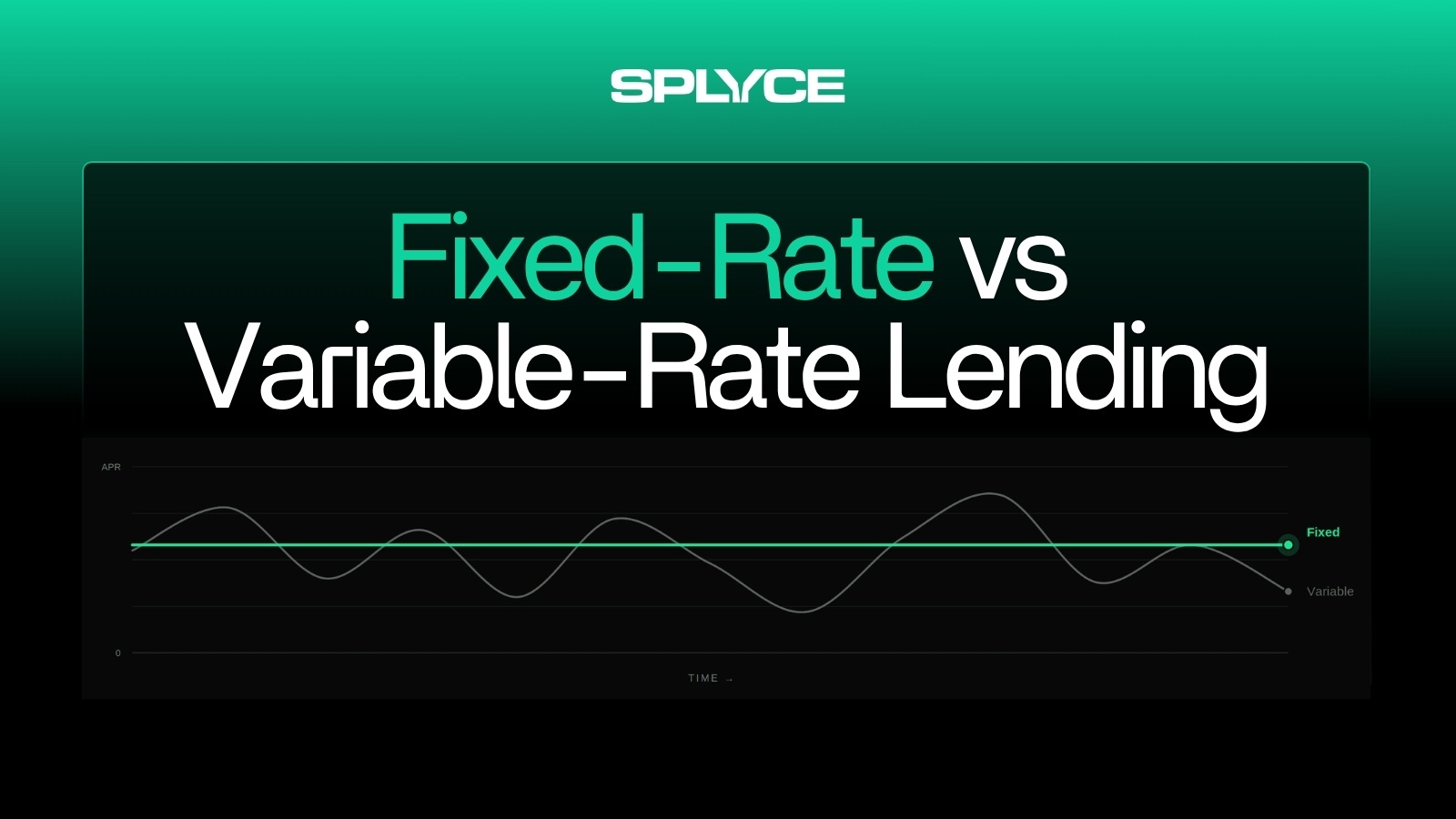
These borrowers are not looking for leverage. They are looking for a bridge between two dates they already know about. That changes what they want from a lender. A rate that will not move, and a maturity that lines up with the thing being financed. LTV and speed of access matter much less than either. A borrower who is financing a business cycle cannot underwrite a cost of capital that reprices weekly.
Why nobody has served them
Reaching those borrowers means accepting what they actually hold: tokenized funds, credit and treasuries that can only move between approved wallets. The issuer maintains a list of who is allowed to hold the asset, and a smart contract is not on it.
That restriction is not an oversight. It is the mechanism that keeps a regulated fund's shareholder register accurate. But it removes the assumption every lending venue is built on, which is that if a loan goes bad the collateral can be sold immediately to whoever bids. There is no open market to sell into, so there is no liquidation path, so the asset does not get listed. One of the fastest growing pools of onchain collateral is unfinanceable for a structural reason nobody is going to legislate away.
This is also where the private banking comparison stops being useful. A securities-based facility is marked daily against listed instruments, with margin calls and a forced sale as the backstop. That works because the collateral trades every day at a price everyone can see. The assets we are describing do not. Copying the mechanics of a product designed for daily-priceable collateral onto collateral that has no daily sale path produces a facility that cannot be enforced. The purpose carries over. The machinery has to be rebuilt.
The result is a strange market. Assets sit on balance sheets earning their coupon and financing nothing, while $60B of lending capacity sits idle waiting for borrowers, and the two sides cannot see each other.
What we are building
Splyce is built to underwrite that market. A named borrower who signs a loan agreement. A rate and a maturity fixed at the start, for both sides. Collateral held in escrow rather than marked to market every block, so a price move in the middle of the term does not unwind a loan that is performing. And a partner committed in advance to take the collateral if the loan is not repaid, which is what replaces the open market that does not exist.
The escrow is the part that has taken the longest, because it is a legal question before it is a technical one. The token never leaves the set of approved holders. The contract holds the collateral as security against a loan rather than as an investor in the fund, the way a custodian holds collateral against a secured facility. That structure has existed offchain for a very long time and simply had no onchain equivalent.
The part we have not proven
Whether these borrowers show up in size, at a rate lenders will accept, is an open question. We think they do, because every one of the situations above is a real financing need that currently gets solved slowly, expensively, or not at all.
But that is a thesis until the first loans are funded and repaid. We would rather say so than pretend the demand question is solved. Plenty of protocols have discovered that a well designed market with no borrowers is still a market with no borrowers.
If you are a fund, issuer or desk that has wanted to borrow against assets you hold and could not, we want to hear what stopped you. Whether it was the collateral, the term, the rate, the counterparty, or the paperwork. That is the most useful thing anyone can send us right now.