Fixed-rate RWA lending sits at the intersection of two ideas that rarely meet onchain: credit priced at a fixed rate for a fixed term, and collateral made of tokenized real-world assets. Most DeFi lending is variable-rate and open-ended. Most real-world-asset products are yield wrappers, not credit markets. Splyce is built around exactly that intersection.
In traditional finance this market already exists, and it is enormous. Holders of high-quality assets borrow against them at a fixed rate for a fixed term instead of selling, then repay and reclaim the collateral at maturity. That is repo, the largest short-term funding market in the world. Fixed-rate RWA lending is that same structure, brought onchain and opened to any wallet.
The three parts
- Fixed rate: the interest rate is set when the loan is created and does not move with utilization, demand, or sentiment. A lender knows the exact yield before depositing.
- Fixed term: the loan has a defined maturity. Principal and interest settle on a known date rather than floating indefinitely.
- Tokenized real-world assets as collateral: the borrower posts onchain representations of off-chain value, such as tokenized Treasuries, institutional money-market instruments, or tokenized private credit, rather than volatile crypto.
A worked example
An institution holds $1M of tokenized US Treasuries and needs stablecoin working capital without selling the position. It opens a Single Asset Vault, posts the Treasuries as collateral, and borrows $600k USDC at a fixed 9% annualized for 30 days. A lender funding that vault knows the outcome on day one: roughly $4,400 of interest, locked at origination, settled at maturity.
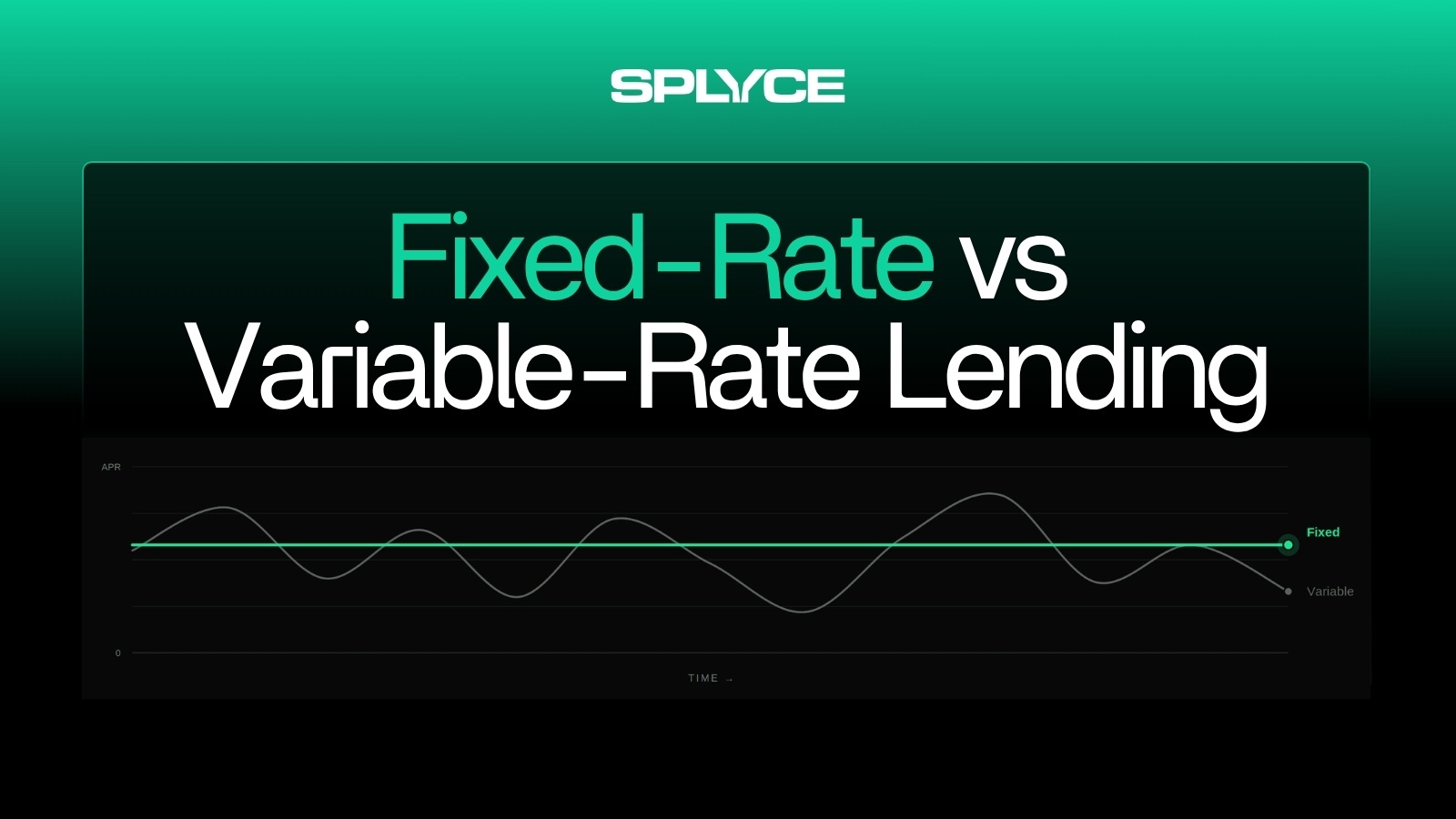
Now lend the same $600k into a floating Aave USDC market instead. The rate might read 6% today, climb toward 12% as utilization spikes next week, and be anyone's guess at maturity. Same quality of borrower demand, completely different certainty about what you earn.
The borrower's side is just as deliberate. An institution cannot run a book against a cost of capital that resets every block. Fixed-rate borrowing is what lets a credit desk, an RWA issuer, or a trading firm quote fixed terms to its own end users. The fixed premium buys rate certainty, the same way a fixed-rate mortgage or a bond issuance does in traditional finance.
How it works on Splyce
Each Single Asset Vault is isolated to one borrower and one collateral type. The borrower completes KYC and signs a Master Loan Agreement; lenders deposit USDC permissionlessly during a funding window, with no KYC and no accreditation requirement. The rate locks the moment you deposit and holds for the full term.
For RWA collateral, vaults are oracle-free by default: there are no price feeds watching the position mid-term and no variable-rate drift, so the loan simply runs to maturity. Resolution is decided at origination, not improvised in a crash. If the borrower repays, lenders receive principal and interest. If they do not, the vault resolves along a path configured up front: for freely transferable collateral, the assets transfer directly to lenders; for collateral that needs an intermediary, a Designated Liquidator settles the position in USDC. Either way, resolution is scheduled and deterministic rather than triggered by a price feed.
Because vaults are isolated, a default in one cannot cascade into another. The loss, if any, is contained to that single vault rather than shared across a pool. Launch on Stellar starts with terms of up to 30 days, expanding as the book grows.
How it differs from everything else
Fixed-rate credit already exists onchain, but priced against crypto collateral: Notional's fCash, Term Finance's auctions, and Morpho's fixed-rate markets all work this way. Permissioned RWA credit exists too, in the institutional pools of Maple and Centrifuge, but it typically requires lenders to be accredited or KYC'd. What none of them offer is the full intersection: permissionless lenders, a fixed rate and fixed term, and tokenized real-world-asset collateral. That gap is the lane Splyce occupies. For the rate mechanics, see fixed-rate vs variable-rate lending; for why the term matters separately, see fixed term vs fixed rate.
How to earn it
There are two ways in. Lend directly into a Single Asset Vault to pick your counterparty, rate, and term. Or hold splyceUSDC, a yield-bearing token that earns a blended rate across the SAV book plus a short-duration liquidity sleeve, giving liquid, passive exposure to the same credit with no term commitment. Its yield floats as a blended rate rather than being fixed, because it spreads across many vaults and maturities at once.
The bottom line
Tokenized assets only become productive once there is a credit market to lend against them. Building that market, and making it open to any wallet, is the whole point of Splyce.