Back to all articles
Education25 March 2026 · 8 min read
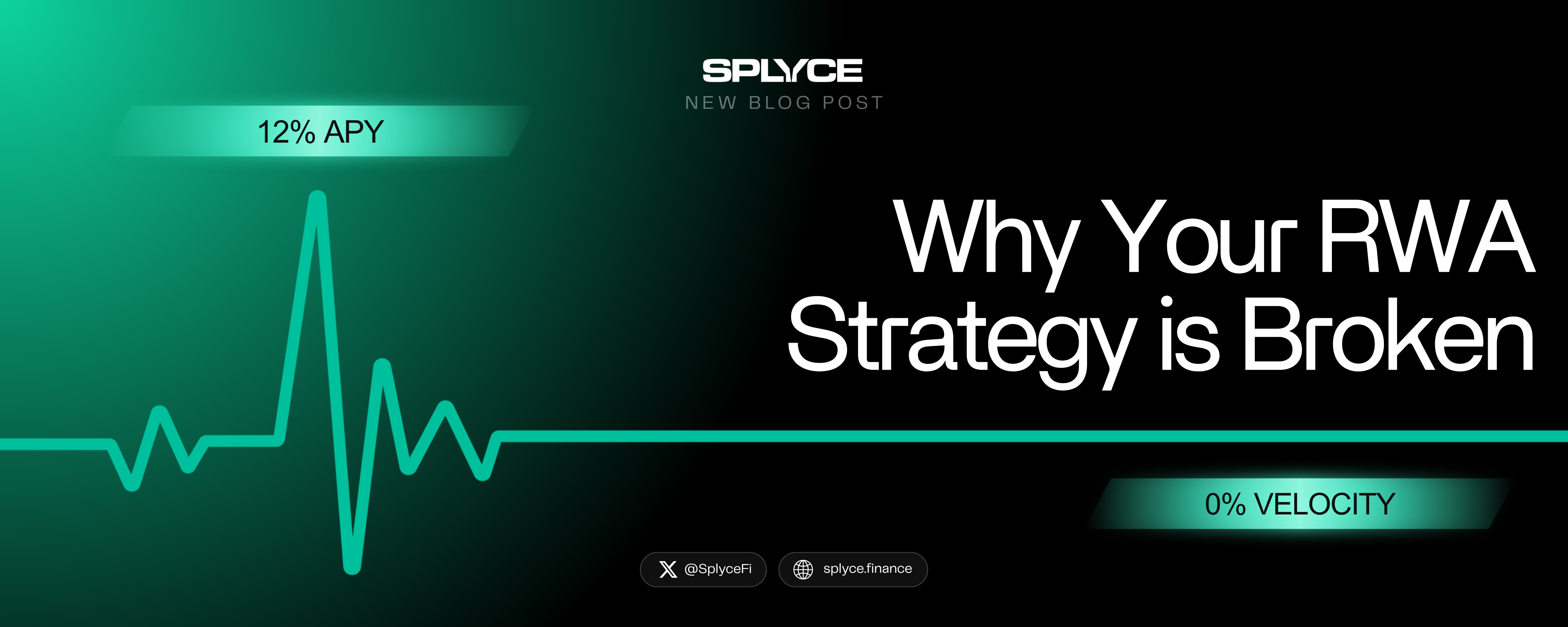
Why Your RWA Strategy is Broken
Most investors are still comparing interest rates instead of comparing what their dollar can actually do. Here's what they're missing.
Most investors are still comparing interest rates instead of comparing what their dollar can actually do. Here's what they're missing.
Most investors in 2026 are still making the same mistake: comparing interest rates instead of comparing what their dollar can actually do.
A standalone RWA vault offering 12% looks obviously better than a treasury position at 5%. It isn't. The reason is a concept DeFi understands intuitively but rarely quantifies: collateral velocity.
Every yield-bearing asset has two properties: what it earns and what it enables. A dollar locked in a standalone RWA vault earns its coupon and does nothing else. A dollar in a liquid, composable position earns its base yield and can be posted as collateral, borrowed against, redeployed, and unwound without waiting for maturity.
The gap between these two states is the utility tax. Illiquid assets pay it silently, it never appears on a term sheet, but shows up in opportunity cost, the inability to rebalance, and the liquidity premium you'd need to offer someone to buy your position early.
The hierarchy is not about return. It's about what a lending market will let you do with the asset.
Tier 1: Pristine. Wrapped treasury tokens and short-duration yield-bearing stablecoins. Deep liquidity, 75%+ LTV, loopable 3 to 5x. Base yield is modest but effective yield after leverage is competitive with anything in Tier 3.
Tier 2: Emerging. Newer yield-bearing tokens like splyceUSDC. Lower LTVs until track record develops, but higher base yield from RWA exposure. Fewer leverage turns, but the math still works.
Tier 3: Dead capital. Illiquid standalone RWA vaults with concentrated single-borrower exposure. Compare this to Single Asset Vaults that maintain composability. That 10-12% is the ceiling, no leverage, no exit, no ability to pivot. Your dollar earns its coupon and sits still.
The critical insight: a Tier 1 asset at 5% with 3x leverage often matches the net return of a Tier 3 asset at 12%, while maintaining instant liquidity and dramatically lower concentration risk. RWA-backed leverage across DeFi lending markets has already surpassed $700 million, as explored in The Rational Borrower, and is growing as crypto-native yields compress.
Three factors that headline APY ignores:
Optionality: liquid positions unwind in minutes when conditions change, while dead capital waits until maturity.
Concentration risk: standalone RWA vaults expose you to a single borrower, while liquid strategies spread across treasuries, multiple protocols, and multiple borrowers.
Compounding: leveraged positions earn yield on a growing base, meaningfully outpacing a flat rate on locked capital over time.
The honest caveat: looping strategies depend on the spread between asset yield and borrow cost. If variable borrow rates spike, that spread compresses or disappears. This is why fixed-rate lending infrastructure matters, predictable borrow costs alongside composable collateral are what define the next generation of yield products.
We don't ask lending markets to trust individual RWA originators. We ask them to trust a diversified yield-bearing token with transparent operations and risk management through diversification.
Our dual-bucket structure combines a Liquid Bucket (roughly 60% in yield-bearing tokenized assets including US Treasuries and investment-grade fixed income) with a Fixed Income Bucket (roughly 40% in direct lending for higher yields). The result is designed to be the most useful token in your wallet, not just the highest-yielding one.
The bottom line
Chase velocity, not vanity yield.
Stay updated
Be the first to hear about news from Splyce.